
Is the Masai Mara Actually Worth It?

We get asked this more than almost anything else, usually by someone who has just seen the park fees and had a small heart attack.
So here's the honest answer from people who send customers there every week and who sometimes talk them out of it.
Short version: the Mara is genuinely one of the great wildlife places on earth. It is also the most expensive park in Africa, it sells you a twelve-hour ticket rather than a full day, and in August you will share your lion with forty other vehicles. Whether it's worth it depends almost entirely on when you go and how you do it.
Let's get into it.
First, the numbers nobody puts on the front page
The Masai Mara is not a national park. It's a National Reserve run by Narok County, and it prices on calendar halves that have nothing to do with the wildebeest.
1 Jan – 30 Jun | 1 Jul – 31 Dec | |
Non-resident adult | US$100 | US$200 |
Non-resident child (9–17) | US$50 | US$50 |
EA resident adult | KSh 2,500 | KSh 5,000 |
Kenyan citizen adult | KSh 1,500 | KSh 3,000 |
Under 8 | Free | Free |
Vehicle (under 6 seats) | KSh 400/day | KSh 400/day |
So a couple driving themselves in August pays US$400 a day just to be inside the gate. Before camping. Before fuel. Before anything.
For comparison, on the same day: Amboseli is $90 a head. Tsavo is $80. Hell's Gate is $50. And all of those are twenty-four hour tickets.
The twelve-hour rule, which catches almost everyone
This is the bit that surprises people, and it's been true since 1 July 2023.
A Mara ticket is valid from 06:00 to 18:00 on the day you enter. It is not valid for twenty-four hours.
If you sleep inside the Reserve, you need to be back out through the gate by 10:00 the next morning or you pay another full day, per person and per vehicle. There's a little tolerance at the scanners. Not much.
Which means a dawn game drive on your departure morning costs you a whole extra day's entry. In August, for two people, that's another $400 to watch the light come up.
Plan your Mara nights knowing this and it's fine. Turn up assuming a 24-hour ticket like every other Kenyan park and it stings.
So when is it worth it?
Absolutely, if you go between January and June.
Entry halves to $100. The park is quieter. The game viewing is still superb, the resident lion prides, the leopards along the Talek, the cheetah on the open ground, elephant, buffalo, hippo, and one of the highest predator densities anywhere in Africa. The migration herds aren't there, but plenty of people think the Mara is a better place to watch cats when there isn't a river crossing sucking every vehicle in the reserve to one spot.
February in particular is lovely. Dry, clear, good light, half price.
Absolutely, if you want a river crossing and you've made your peace with the cost.
The crossings cluster in July and August. The herds then spread out across the Mara through September and October, and head south again with the short rains in November.
Nobody can tell you a date. As every honest guide in Kenya will say: there are no fixed dates, because the herds follow the rain. Anyone publishing "2027 crossing dates" is making them up.
If a crossing is your dream, budget for four nights rather than two, because it's a waiting game.
Probably not, if you're squeezing it into a two-week loop.
This is the one we most often gently steer people away from. A Mara detour on a fortnight's circuit usually means two long driving days (it's about seven hours from Nairobi to Sekenani, not the five you'll see quoted), two nights on the ground, and $400 a day for a couple in high season for a park you've barely scratched.
That same money and time gets you three nights in Amboseli with elephants under Kilimanjaro, or a proper run north to Samburu.
The crowding question, answered properly
It's real, and it's concentrated.
In the National Reserve during a July or August crossing, a good sighting can pull thirty or forty vehicles. That's the photograph you've seen doing the rounds on social media, and it isn't a myth.
But the Mara is big, and the crowding follows the crossings. Go in February and you'll have long stretches to yourself. Go into the Mara Triangle - the western sector, run by the Mara Conservancy rather than Narok County and it's consistently quieter than the eastern side.
The conservancies bordering the Reserve (Naboisho, Olare Motorogi, Ol Kinyei, Mara North and others) cap the number of vehicles at a sighting, usually at five. They're the answer to crowding, but they cost US$80-150 per person per night, usually bundled invisibly into a camp rate, and here's the thing we'd rather tell you straight:
Conservancies don't allow self-drive. You can generally only drive in one if you're staying at a camp inside it, and most require a resident guide with you. Mara North is the partial exception, and even then you need to ask first.
So if you're driving yourself, you're in the Reserve or the Triangle. Which is absolutely fine just go in low season.

The Mara Triangle is the self-driver's secret
Two reasons.
One: it's quieter, greener, and the road network is better maintained.
Two, and this is genuinely under-published: the Mara Triangle permits off-road approach to lion, leopard and cheetah within 25 metres in its Low-Use Zones. That's the only legal off-road big-cat access available to a self-driver anywhere in Kenya. Everywhere else, you stay on the track.
Two things to know before you go:
It's a separate ticket. Same price, different collecting authority. A Narok-side ticket is not valid in the Triangle and vice versa.
If you're staying in the Triangle but entering at Sekenani, do not pay at Sekenani. Ask for a two-hour transit pass and pay at Purungat Bridge instead. Get this wrong and you'll pay twice.
The Triangle is also strictly cashless - card or M-Pesa only and it wants your passport, not your driving licence, as proof of nationality.
Can you actually drive yourself in the Mara?
Yes, with a proper vehicle. This confuses people because Narok County announced a ban on private vehicles for game drives in June 2024. It was never formally rescinded, but it isn't enforced as a ban.
What it turned into is a vehicle inspection at the gate, and those are real.
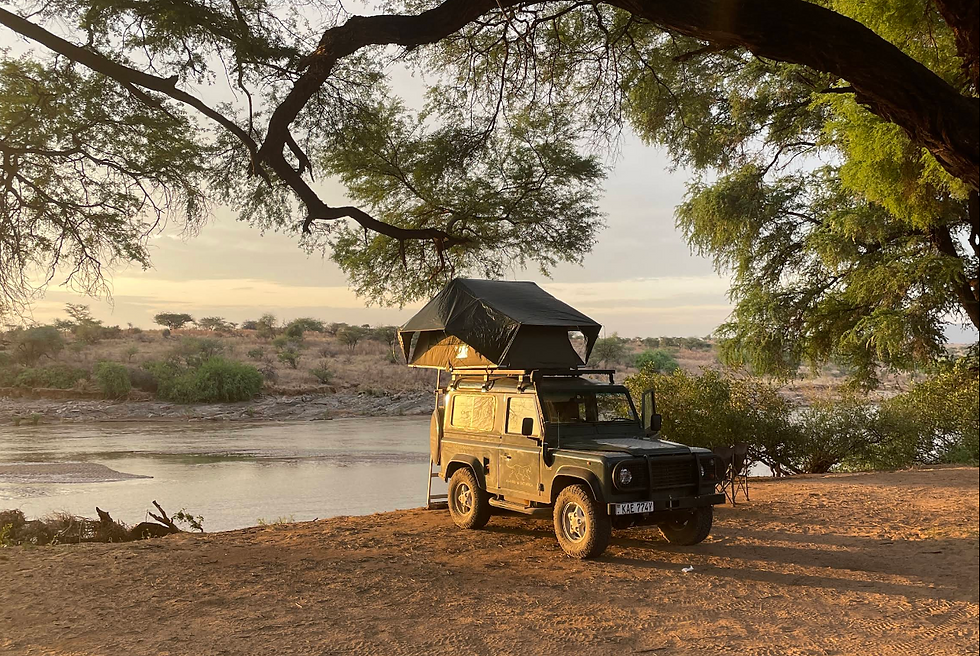
What gets waved through: a genuine safari-spec 4x4 with working low range, good ground clearance, a pop-top or roof hatches, and spare wheels. A Land Cruiser 76 or 79, a Land Rover Defender, a Hilux double cab.
What gets turned around: standard all-wheel-drive SUVs without low range, rental RAV4s, saloon-based crossovers, and anything with visible leaks. Enforcement varies by gate - Talek is the strictest we've seen.
If you're hiring a vehicle to drive into the Mara, ask the company directly whether it has true low range.
Every vehicle in our fleet does, which is why we've never had one turned back.
And no a ranger isn't compulsory in the Reserve, despite what some older articles say.
One's available at the gate for roughly KSh 1,500–3,000 depending on how long you want them, and honestly on a first visit they're worth it just for the navigation. A ranger is mandatory if you take a private campsite.
What we'd actually recommend
If the Mara is the whole point of your trip: go January to June, give it four nights, base yourself in the Triangle, and use the money you saved on fees to stay somewhere lovely.
If you want a crossing: July or August, four nights minimum, book a long way ahead, the good camps go twelve to eighteen months out and accept the cost and the company.
If you've got two weeks and want the best trip Kenya can give you: honestly? Amboseli, Tsavo and Samburu. Elephants against Kilimanjaro, red dust and lava flows, and a northern desert full of animals you can't see anywhere else. It costs about half as much in gate fees and you'll see almost nobody.
That's the trip most of our customers end up doing, and it's the one they write to us about afterwards.
Rough costs, two people, three nights in the Mara
Jan–Jun | Jul–Dec | |
Entry, 2 adults × 3 days | $600 | $1,200 |
Vehicle, 3 days | ~$9 | ~$9 |
Public campsite, 2 adults × 3 nights | $180 | $180 |
Fees subtotal | ~$789 | ~$1,389 |
Add fuel, add your vehicle, add food. And note that going in the first half of the year saves a couple $600 on the same trip.
Fees last verified 25 August 2026 against Narok County's published tariffs and the Mara Conservancy. Kenyan park fees move - always check before you travel.


Comments